I want to start with an admission.
I used to think karma was simple. You do good, good comes back. You do bad, bad comes back. A cosmic scoreboard. A universal justice system that keeps everything balanced.
Then I started having conversations with people who actually understand it — spiritual practitioners, Vedic scholars, army officers who've seen life and death up close, and philosophers who've spent decades studying these concepts.
And I realised I was wrong. Not slightly wrong. Fundamentally wrong.
The 3 Types of Karma Nobody Explains
In Hinduism, karma isn't one thing. It's three.
Sanchita Karma — the accumulated karma of all your past actions. Every lifetime, every decision, every word spoken in anger or kindness. Think of it as your total account. You can't see the full statement, but it's there, influencing everything.
Prarabdha Karma — the portion of your accumulated karma that's been activated for this lifetime. This is what determines your circumstances at birth, the family you're born into, the challenges you'll face. This isn't punishment. It's your curriculum. The lessons your soul signed up for.
Kriyamana Karma — the karma you're creating right now. With every choice, every reaction, every word. This is the only karma you have direct control over.
When people say "it's my karma" as an excuse for passivity, they're missing the point entirely. Yes, your past karma created your present circumstances. But your present actions are creating your future reality. You're not a passenger. You're the driver.
The Mahabharata Lesson That Changed My Perspective
I had Devdutt Pattanaik on the podcast — "Find Out the Hidden Truth of Mahabharata & Ramayana" — and what he shared wasn't what I expected.
He didn't retell the stories. He decoded them.
The Mahabharata isn't just an epic. It's the most sophisticated manual on human psychology ever written. Every character represents a different facet of the human condition. Arjuna's doubt isn't about a battlefield — it's about every moment in life when you know what's right but can't bring yourself to do it. Draupadi's fury isn't about revenge — it's about the righteous anger that comes from being treated unjustly by the very people who should have protected you.
The lesson? These stories aren't ancient history. They're a mirror. And if you look honestly, you'll find yourself in every character.
The Colonel's Spirituality
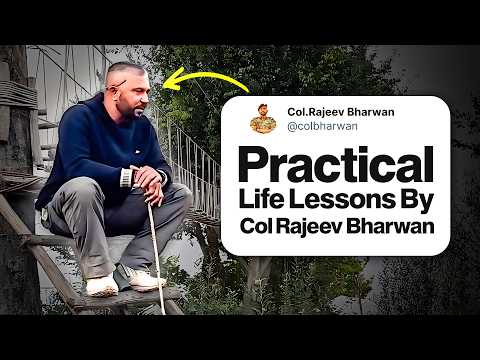
One of the most spiritual conversations I've ever had wasn't with a guru or a priest. It was with Colonel Rajeev Bharwan. A military man. Someone who has sent men into battle. Someone who has attended funerals of soldiers younger than most of us reading this.
His perspective on karma was earned, not studied. He said that when you see death regularly, you stop debating whether karma exists. You feel it. The universe has an order. Not a convenient order. Not always a fair-looking order. But an order.
What I took from that conversation: spirituality isn't about sitting in a temple. It's about how you behave when life is at its hardest. Your real spiritual practice is how you treat people when you're under pressure. Everything else is just performance.
Spirituality vs. Religious Performance
I'm going to say something that might be uncomfortable.
Going to the temple every Tuesday doesn't make you spiritual. Wearing a particular bracelet doesn't raise your vibration. Posting om on Instagram isn't a practice.
Spirituality is how you respond when someone cuts you off in traffic. It's whether you choose forgiveness or resentment when someone hurts you. It's the conversation you have with yourself at 3 AM when no one is watching and the mask is off.
India is one of the most spiritually rich civilisations in human history. And yet, we've somehow reduced that richness to rituals, superstitions, and Instagram reels about chakra healing.
Real spirituality is inconvenient. It asks you to look at yourself honestly. To admit your flaws. To take responsibility for your reactions. To stop blaming karma for the mess you created with your own choices.
How to Actually Raise Your Vibration
I know "raising your vibration" sounds like something from a new-age seminar. But the concept behind it is rooted in something real.
Your emotional state has a frequency. When you're in gratitude, love, or creativity — your decisions are better, your relationships are healthier, your energy attracts opportunity. When you're in fear, anger, or resentment — the opposite happens. Not magically. Practically. Because your emotional state determines your behaviour, and your behaviour determines your results.
Here's how to shift it. Not overnight. But consistently.
First, audit your inputs. What are you watching? What are you listening to? Who are you spending time with? If your diet of information is outrage-based news and toxic social media, your vibration will match. Garbage in, garbage out. This applies to consciousness as much as it applies to computers.
Second, practise gratitude that isn't performative. Not "I'm grateful for my life" posted online. Actual, private, specific gratitude. "I'm grateful for the fact that I had a conversation with my mother today and she was healthy enough to argue with me about lunch." Specific gratitude rewires your brain to scan for positives instead of threats.
Third, forgive somebody. Not for them. For you. Resentment is like drinking poison and expecting the other person to get sick. Every grudge you carry is a weight on your energy that makes everything harder.
Karma and Relationships
This is where karma gets deeply personal.
I've noticed a pattern across hundreds of podcast conversations: the relationships that cause us the most pain are often the ones that teach us the most. The partner who broke your trust might have been the catalyst that taught you self-worth. The friend who betrayed you might have been the lesson that taught you boundaries.
This isn't about justifying bad behaviour. It's about finding the lesson inside the pain. Because if you don't find the lesson, karma will send you the same lesson again. Different person. Same pattern. Until you finally learn it.
If you keep attracting the same type of toxic relationship, the universe isn't punishing you. It's teaching you. The question is whether you're paying attention.
Watch the Full Episodes
This post draws from Divya Jain Podcast episodes including "Warning: This Podcast Will Change How You See Your Life Forever" ft. Col. Rajeev Bharwan, "Find Out the Hidden Truth of Mahabharata & Ramayana" ft. Devdutt Pattanaik, and "Swami Mukundananda Reveals Shri Krishna's Secret Method of Manifesting Success."